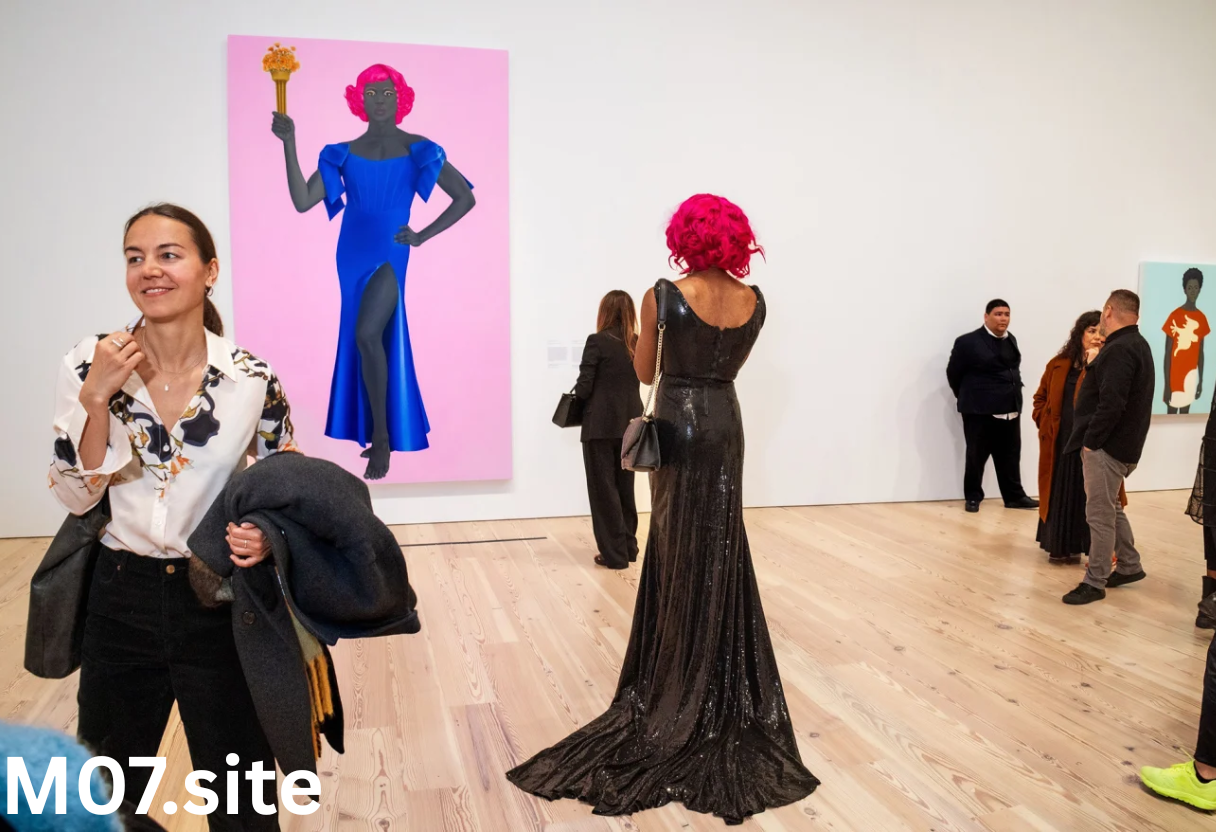
In President Donald Trump’s second term, the American art world is facing an escalating crisis. Federal support for the arts is shrinking, political scrutiny over cultural expression is rising, and many museums are staying silent — either out of caution or fear of retaliation. Experts and advocates are calling it nothing short of a “national emergency” for the country’s cultural institutions.
A High-Profile Cancellation Sparks Concern
In July, acclaimed artist Amy Sherald, known for her portrait of Michelle Obama, cancelled a major solo exhibition at the Smithsonian’s National Portrait Gallery. The decision followed disagreements over how her painting — depicting the Statue of Liberty as a Black, transgender woman — would be presented. Sherald later accused the museum of censorship, warning that government control over art institutions is a dangerous path with historical precedents.
Her cancellation drew attention to what many see as a broader trend: the Trump administration’s increasing efforts to influence federally funded museums, especially those that engage with topics like race, gender, and identity.
In March 2025, the administration issued an executive order requiring museums like the Smithsonian to eliminate so-called “improper ideology” and focus instead on promoting “American exceptionalism.” Following this, the government requested detailed information from museum staff — including exhibit plans, artwork selection processes, and internal communications.
The director of the National Portrait Gallery resigned soon after, and the Smithsonian created a special team to respond to federal demands.
A Culture of Silence
As political pressure grows, many museum directors and curators across the U.S. are choosing not to speak publicly. CNN reached out to more than a dozen arts leaders, but most either declined to comment or said little, reflecting a field that’s increasingly quiet — and, some say, increasingly cautious.
According to the American Alliance of Museums (AAM), many institutions are feeling external pressure to alter or cancel exhibitions that might be seen as controversial. The AAM issued a formal warning about rising censorship and a “chilling effect” that’s spreading across the museum sector.
From Washington to the Nation: A Spreading Impact
The Trump administration has already slashed funding for key national arts organizations like the National Endowment for the Arts (NEA) and the National Endowment for the Humanities (NEH). As a result, many grants have been cut, denied, or withdrawn — including multi-million dollar programs supporting museum exhibitions and education.
At the Seattle Art Museum, Director Scott Stulen said his institution lost $700,000 in federal grants this year alone. He added that museum directors nationwide have been told to stop budgeting for federal support altogether, expecting that little or no funding will return under the current administration.
For some institutions, the financial hit may be only part of the threat. Losing tax-exempt status, which the administration has publicly threatened for nonprofits deemed “politically biased,” could cripple many museums. Without that status, donations are no longer tax-deductible, and eligibility for certain grants would vanish. Smaller organizations would likely struggle to survive.
Self-Censorship and Silent Resistance
Behind the scenes, some museums are choosing to quietly remove references to diversity, equity, and inclusion (DEI) from their websites and programming. Others are altering exhibitions before they open, fearing political backlash. One federal museum in Washington, DC, reportedly canceled two exhibits by Black and LGBTQ+ artists earlier this year. The decisions were allegedly tied to a January executive order that restricts DEI initiatives in federally funded institutions.
In contrast, a few institutions are pushing back. The Leslie-Lohman Museum of Art in New York — the only major museum in the U.S. dedicated to LGBTQ+ art — has taken a bold stance by hosting exhibits that were rejected elsewhere. Executive Director Alyssa Nitchun said her museum is choosing to “be louder, to be stronger,” especially in the face of government efforts to suppress marginalized voices.
Similarly, the Seattle Art Museum recently hosted the largest U.S. exhibition of works by Ai Weiwei, a Chinese artist known for his critique of government oppression. For Stulen, the exhibit sends a powerful message about the importance of protecting artistic freedom.
Nationwide Statement, But Missing Big Names
In August 2025, more than 250 arts organizations and hundreds of individuals signed a public statement urging museums to remain independent from political interference. The document, created by the Vera List Center for Art and Politics, warned that cultural spaces must not become tools for government propaganda.
Notably, however, most large and prominent museums did not sign the statement. Organizers expressed disappointment, but noted that the signatories represented every state and region, showing broad national concern.
Controversy Over Federal Intentions
The White House has stated that its goal is not censorship but “accountability and transparency” in how federal funds are used. A spokesperson told CNN that taxpayer dollars should not support what it considers “ideological or partisan content.”

However, critics argue that the administration’s definition of “improper ideology” is vague — and that its actions amount to political interference. Terminated grants have targeted projects featuring Indigenous, queer, and racially diverse artists, including an exhibition on Jeffrey Gibson, the first Indigenous artist to represent the U.S. solo at the Venice Biennale. According to the Massachusetts Museum of Contemporary Art, funding was pulled because the show didn’t align with the administration’s “new priorities.”
Wider Cultural Implications
Janet Marstine, a scholar of museum ethics, noted that even limited acts of censorship can send a powerful message, causing “a domino effect” of fear and self-censorship across the sector. Other experts warn that narrowing the scope of cultural storytelling — focusing only on sanitized or selective versions of history — risks turning museums into instruments of propaganda.
“Art must show the full story — the good and the painful — or we lose our collective memory,” said Cesáreo Moreno, director of visual arts at the National Museum of Mexican Art.
DEI Under Fire
Beyond museums, Trump’s administration has declared many DEI programs “illegal,” targeting both public and private sectors. The White House says it will only fund programs that are not “discriminatory,” but hasn’t clearly defined what qualifies.
In response, some institutions are removing mentions of DEI altogether. But others are refusing to back down. William T. Fujioka, chair of the Japanese American National Museum, issued a statement saying they would not abandon their commitment to diversity.
A Divided Moment in American Art
During Trump’s first term, many museums embraced social justice themes, hosted shows on racial and gender identity, and worked to acknowledge colonial histories through actions like repatriating looted artifacts or recognizing Indigenous land. But now, under renewed federal scrutiny, even formerly bold institutions appear to be retreating.
Amy Sadao, a former museum director and consultant, says part of the issue lies with museum boards — often made up of wealthy donors who may not support the values their institutions claim to uphold. These board members have significant influence over what gets shown and funded.
“What we’re seeing isn’t just a fight over DEI,” Sadao said. “It’s a narrowing of the entire definition of American culture — a vision that centers whiteness and erases other histories.”
The White House has strongly denied any accusations of white supremacy, calling them “false and inflammatory.”
A Fight for Cultural Survival
Despite the tension, public support for arts funding remains high. A 2023 national survey by Americans for the Arts found that the majority of Americans — across political lines — support public funding for the arts.
But museum leaders warn that if the current trend continues, access to diverse and thought-provoking art may disappear for many communities. Fewer people will feel welcome, and fewer stories will be told.
“We’re living in a time where cultural expression is under threat,” said SAM’s Stulen. “The fact that this administration is trying to control what we can show — that just proves how powerful the arts really are.”